What makes a great product manager?

This topic has been covered by many, many bloggers.  Yet most have written from locales such as the U.S., where things are different from my current home.

I’ve been thinking a lot about the challenge of building a great product management team here in the Czech Republic.  Particularly given the relative dearth of software vendors, which means that experienced product managers are in scarce supply.

Experience is a tempting credential to rely on when hiring.  Product management, to paraphrase my esteemed colleague Alan Lefort, is more like a trade guild than a university-taught profession (despite the lively debate over on Cranky Product Manager a few weeks ago).

First, I started thinking about good product managers I’ve known in the past, from places such as San Francisco or Boston.  What was in common beyond the obvious experience they had in software product management?

I also thought about the less-than-great product managers I’ve known, and even hired.  All had the requisite experience, but somehow that wasn’t enough.

So if it isn’t experience per se, nor a formal degree, what is it?

Intellectual curiosity.

Without exception, great product managers are great learners.  Their innate curiosity means they are always in a mode of learning.  It could be reading a book, or asking great questions of others in their own company, or networking with experts, etc.

I’ve recently toyed with intellectual curiosity as a primary interviewing topic.  You would be amazed at the disparity of answers from otherwise qualified candidates.  Some couldn’t cite any example of how they pursued their curiousity to better their work.  Others gave tremendous answers.

The most memorable example of late: a user experience designer told me he learned anatomy in order to better understand how people interact with computer interfaces.  And that he studied corporate finance in order to better measure the impact of usability improvements on his product’s financial performance.  Wow.

(Note from the cynic in me to future applicants: don’t confuse knowing my hiring criteria with meeting them.)

One of the greatest effects of the Internet is the extreme democratization of knowledge.  There’s no reason to not be curious; so much knowledge is free.  Those product managers who are curious will be richly rewarded.  Those who aren’t are going to be left behind.
The Christmas that was – then wasn’t – then was

Beyond the need to vent about the experience my family and I just had, I suppose I write this in empathy for the thousands of other families who suffered a similar fate this week.

Of course, I’m writing about the epic failure of the European airline system, and the untold numbers of families who weren’t reunited on either side of the Atlantic for Christmas as a result.

Our journey to North America was intended to start with a flight to Heathrow from Prague last Monday.  Then a non-stop flight on Tuesday morning to Halifax, Canada.

The reality: our flight to London was cancelled.  We managed, thanks to a resourceful travel agent, to fly to London Luton that night on “WizzAir”.  A Hungarian airline that clearly has no plans to serve North America given the term “wizz” stands for, well, having a pee.

A $100 taxi ride later and we were nicely ensconced in our Heathrow hotel.  The lobby of which looked like a refugee camp; dozens of dazed and confused travelers milling about wondering whether they were going anywhere.  And surely some of whom had been there since the Friday before, when all of this mess broke out.

Come Tuesday morning, our flight to Halifax had been cancelled.  We waited all day to hear from the travel agent about alternatives.  As in, any desitination in Eastern Canada or Northeast U.S.  Zippo. Nada. Nul.  Air Canada said the earliest available flight to Canada would be December 30th.

Meanwhile, we were looking for another hotel for the night.  The one we were in would gladly put us up another night at double the cost.  My son wanted to stay; he couldn’t get enough of jumping between twin beds in his adjacent room to ours.

So, another $100 taxi ride to a more distant outpost hotel from Heathrow.

By Tuesday afternoon, hope was lost and it was more a question of whether we could even get back to Prague.

Tuesday night we decided that living well is the best revenge.  And hopped a train into London for a great curry meal and some relief from the four walls of a hotel room.  On the ride back, a friendly train-mate charmed our son.  It’s these random encounters with interesting people that make travel worthwhile.

Wednesday morning arrived with a 5am wake-up call and a trip to London City Airport.  We had secured a flight to Amsterdam, with a connection 6 hours later to Prague.

Another $100 taxi ride later, and we arrived at the airport.  If the hotel lobby at Heathrow was like a refugee camp, then the scene at this airport was like the evacuation of Saigon.  Thousands of distressed refuguees travelers queued up in the cold outside the terminal, unsure of how & when they could enter and check in.

An hour after we arrived, the police showed up in force.  Somebody wisely surmised that with this many people, and this little coordination of the queues, something nasty could occur.

2 hours later, we reached the check-in counter.  Bags piling up in heaps.  Children crying (including my own).  Airline employees busily conferring, trying to figure out what to do in the face of utter, systemic break-down.

Once aboard the plane, the captain announces that bags had been loaded for passengers not on board.  A major security no-no.  2 hours later, every bag was finally accounted for.

The rest of the day was mostly without incident.  We spotted some cots and blankets in use at Schipol Airport in Amsterdam.  More signs of the European air travel melt-down.

On arrival in Prague that night, we simply assumed our 4 checked bags were lost, perhaps forever.  Miraculously, 3 bags arrived and only a child’s car seat was missing.

So it was the Christmas that wasn’t.  But the story ends on a better note.  As expast are wont to do, we have invited some friends for Christmas dinner, secured a frssh turkey to cook, a couple of magnums of nice Italian wine, and many other delicacies.

Christmas might not have come off to plan, but the company of friends in a foreign land and the comfort of good food will soften the disappointment of missing one’s family.

May the thousand of others so affected this week be as lucky as us.  God speed!

2010 in review: change or be changed

With apologies to those who cringe at the “holiday letter”, here comes……the blog equivalent.

I can’t remember another year in my, ahem, 45 year life that was marked by more change.  I changed jobs.  We moved to Europe.  My dad died.

All of this before April!

In January, I found myself in lovely, freezing, windy Overland Park, Kansas helping to consummate an acquisition of Archer Technologies by RSA.  Weekly trips for the rest of the year were in order from my home in Boston.

Something managed to interrupt that plan, though the seeds were sown in November 2009.  A random call from a search firm started a conversation about a company I had never heard of – AVG – and their interest to hire someone in Prague.  By December 2009, I had decided this wasn’t for me.

Fast forward to February, and my wife and I are in Prague to visit AVG and check out the city.  I guess the opportunity grew on me (us).

By March, I had resigned from RSA and agreed to move to Prague in April.

I landed in Frankfurt on the 16th of April to an airport closed by volcanic ash.  I had a cat and a briefcase.  Lufthansa decided to hang on to my luggage, as I continued on my planes, trains and automobiles buses journey to get to Prague that evening with my cat (now covered in pee after 20 hours in a crate).

I spent the weekend shopping like crazy as if my luggage would never arrive.  New eyeglasses (contact lenses left in suitcase, d’oh!), kitchen tools, underwear, socks, work shirts.  You name it.

Without a cell phone, I had to wait until Monday to call my wife and my family.  The second call I made was to my sister, to inquire about how my dad was doing in the hospital. He died 10 minutes prior.  Read more about him here.

Fast-forward to July and the arrival of my wife and son to Prague.  After 3 furious months of work, it was time to re-balance one’s life and re-connect with those who are most important.  Oh yeah, and to find a home.

In September, we returned to Boston and Nova Scotia to visit family and friends.  Surreal sense of “not belonging here” while not belonging to Prague yet either.  Though this will pass.

By October, my wife was throwing a gala Halloween party for 90 adults and kids.  Life was back to (the new) normal.  Which leads us to today.

I have the habit of writing blog posts about specific stories, then summing them up with some sort of “truisms” or “reflections”.  When reviewing the events of an entire year, how can I resist this time?

The conclusion? It all comes back to change.  How do you react to it?  With resistance, fear and anger?  Or do you seek it out?  Do you control it, lest it control you?  To enjoy it, even.

My persona at work is often perceived as a conformist.  Yet I would like to think I’m one to initiate change.  I suppose this makes me confusing to others at times.  But I wouldn’t have it any other way.  Change on….

Christmas, Czech-style

The Czech Republic is reputed to be the most secular country in Europe.  Something like 60% of its citizens either don’t practice their religious affiliation or are agnostic.  Yet the Christmas holiday season is in full swing and appears to be a serious matter here.  Go figure.

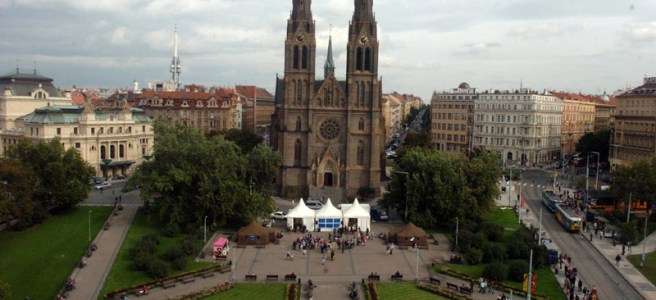
The Christmas market outside my flat at Namesti Miru is the picture postcard of charming.  A huge tree is decorated and lit in the middle of the square.  Small wooden stalls surround the tree, selling handmade crafts.  And, more importantly, some sort of fried dough with cinnamon is on offer.  And hot mulled wine that you consume at stand-up tables.  Meanwhile, the beautiful church of “Saint Ludmila” looms in the backdrop.

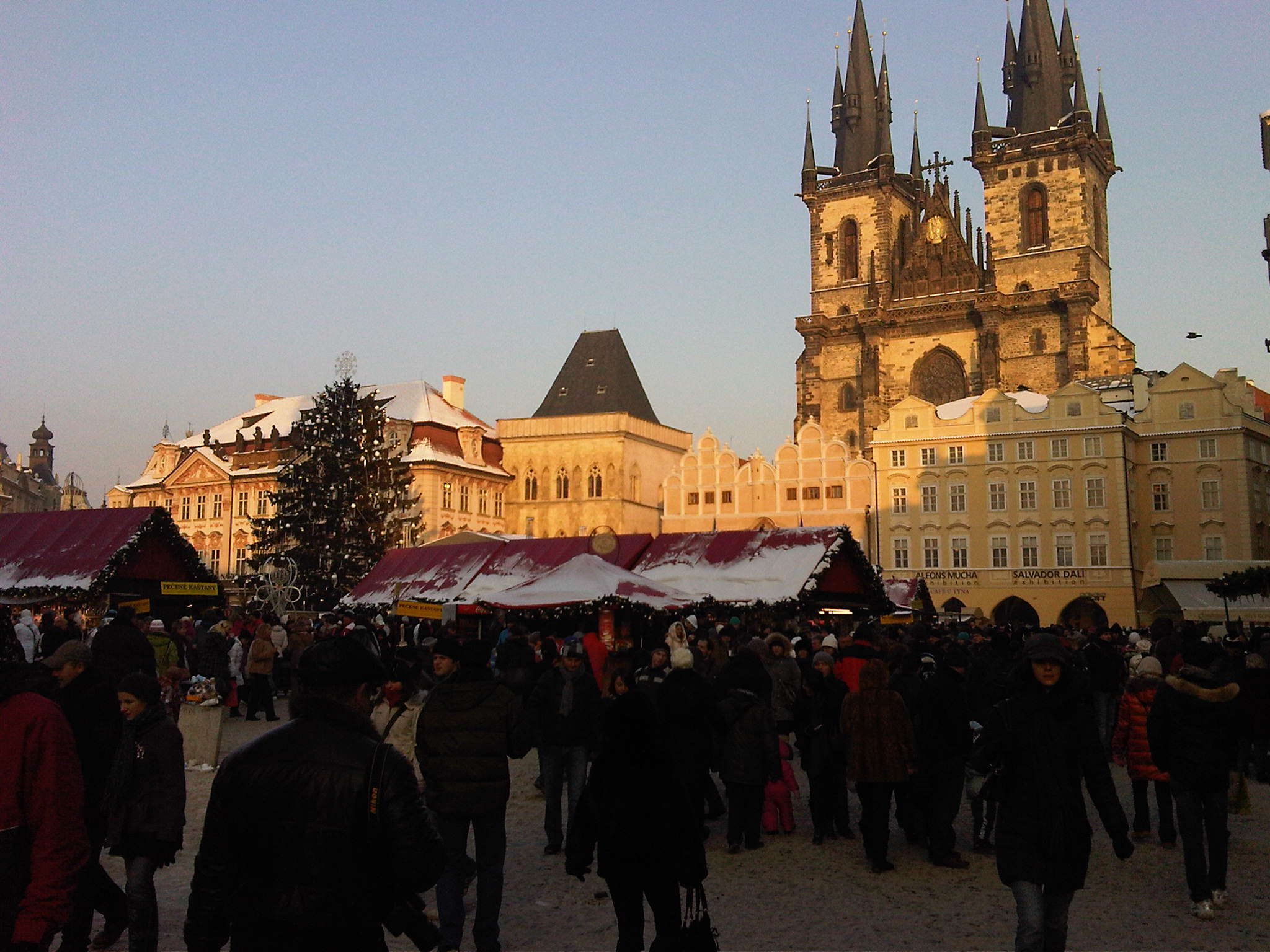
All across the city, beautiful old buildings are adorned with lights.  Even the street lamps have holiday lighting attached.  Several days of snow have made the city more charming and festive still.  Including Old Town Square:

Christmas market at Old Town Square in Prague

Then there’s the vacation time off.  When planning a recent product release, we assumed that no development work would be done for the last two weeks of the year. Everybody is off for at least a week, and many for two.  You would otherwise assume that Christmas is one serious religious observance for the country as a whole.

In the few months of writing this blog, my Czech friends have demonstrated that they don’t get my irony and sarcasm.  So let me be clear.  I am not criticizing those who are in fact religious and for whom Christmas is a big deal.  Somehow the spirit of this holiday has transcended religious meaning if you’re to believe the statistics about secularism.

In the end, how is that a bad thing?  Merry Christmas!

Coming: the year in review.

Is a Private Internet Coming at Last?

Maybe I’m the last to the party of prognosticators that have long predicted the emergence of multiple or private internets over time.

But it does feel like something big is brewing in the world of consumers and the internet.  Time spent online is growing, at the expense of television viewing.  Time spent online is shifting, to social media.  Big user bases of 100 million and larger are emerging, from Facebook’s nearly 600 million to Twitter to Zynga to Last.fm to LinkedIn.  And let’s not forget Yahoo’s and Google’s  hundreds of millions of monthly users that have been with them for years. Let’s call these sites the  Cabal.

And there’s the dimension of capitalism.  Today, about $30b is spent annually on online advertising.  Google earns a whopping 87% of that money.  Meanwhile, Facebook has rocketed from 9% of U.S. online advertising revenue share a year ago to 23% today, overtaking Yahoo! along the way.  The Cabal is gearing up for a fight over users money and it’s going to get nasty.

So, we’re converging as users on these social media sites.  And these sites are vying for big advertising bucks in turn.

Where does that leave the rest of the internet?   You know, the billions of other web pages.  Has it been rendered less relevant?  Or does is contain the classic “long tail” of content that makes it valuable for each of us in highly personal ways.

The idealist in me says that the Internet in whole – this embarrassment of riches – is deeply rewarding to us all and will continue.  The capitalist in me says that with so much money at stake, the Cabal will shape the future.

Where do you stand?

San Francisco days and the “failure stigma”

I just wrapped up a week-long trip to Silicon Valley.  Despite traveling here probably 70 times or more over the years, I always feel the special energy of the place.  And it energizes me in turn.

Lots has been written about Silicon Valley’s culture of innovation and the appreciation of good ideas and smart people.  But what distinguishes this place the most, in my opinion, is the acceptance of failure.

Failure is the inevitable by-product of innovation.  After all, most innovation fails to live up to its commercial promise.  But nowhere else in the world is there a systemic lack of the “failure stigma”.   And somehow this unleashes a form of creativity that is less constrained by concerns about eventual success or failure.

An example: have you ever been in a brainstorming meeting with colleagues?  Where you came out of the meeting with some really good ideas?  Did you notice that few if any of those ideas were implemented?  Maybe it’s the “failure stigma” that stood in the way.

I think managers and executives are the source of the stigma.  And those who punish failure and reward success in binary terms are losing the subtleties of two things.  First, why was a success a success?  We often don’t actually know.  So how do we know how to replicate success?

Second, what can be learned from the failures to apply to the future?  It’s not “don’t screw up again”.  Though these are the signals we tend to send.

So, should the rest of us turn into wanton risk-takers?  Not exactly, given the cultures of the many other places in which we live.  But a good start would be to create a culture that inspects past failures and seeks to learn.  Without punishment.

Awkward times at the RSA Conference

I was at the RSA Conference in London this week.  As a recently-departed employee of the company that hosts the conference, it was a bit awkward.  On the one hand, these people were my colleagues and friends.  It was great to see them and have a beer.

On the other hand, both I and they have moved on.  Lots has changed at RSA since I left, so their recent history is divergent.  And I’m working in a market sector mostly unrelated to theirs, so there’s fewer shared business topics to talk about.

Perhaps the most awkward bit was trying to strike a balance between being friendly and not spending too much time lingering.  I don’t know about you, but in the past I’ve encountered ex-employees at conferences where you get the sense that their lingering equals longing.  As if they regretted leaving your company and yearned for the good old days.

I’m completely at peace with my choices.  I wouldn’t trade my time at RSA for anything, nor would I second guess my move to a new & exciting company where I’m constantly challenged and learning new things.  But I certainly miss my friends.

There is a slightly antique word “gadfly” that comes to mind.  Seems apropos, at least the annoying bit.  As in, don’t be a gadfly at the RSA Conference.

My media holiday

I’ve been on a U.S. media sabbatical for six months.  I don’t miss it.  And my perspective is slowly changing about my country.

Before I left Boston this year, I was a pretty voracious consumer of news media.  I spent 30-45 minutes reading the Boston Globe cover to cover every day.  I watched the morning newscast before work.  I read my Yahoo! portal page.

Was I a media junkie?  I didn’t consider myself one, if only because I didn’t watch political commentators on Fox News, CNN or MSNBC.  I guess on reflection I was pretty close though.

Today, I don’t have cable or satellite television service (yet).  As I wrote earlier, there’s so much content on the internet that my television functions mostly as a giant monitor for watching iTunes, or streaming TV shows from websites, or watching DVD’s.  The amount of news content I consume has dwindled to a daily skim through the Yahoo! portal and occasional visits to Boston.com.

Having disengaged for a while, it now seems like U.S. media is a tempest in a teapot.  For example, there is a hysteria by which journalists and commentators focus on even the most minute differences between parties on issues.  It’s divisive.

It’s also unfortunate because it serves to distract the citizenry from the real issues.  The big issues.  Such as?

For one, that the U.S. is a huge net debtor to China, given its addiction to inexpensive  Chinese goods (note I didn’t say cheap, or shoddy).  China will surely use its vast holdings of U.S. currency to exercise its interests, and at the expense of the U.S.’

Or, that the cost of health care is materially affected by the degree to which patients receive preventative care.  Waiting until you need to go to the emergency room because you couldn’t afford medical coverage is the best way to ensure costly care of what would then be an acute or chronic condition.  On principle, why can’t the government incent preventative care as a form of industrial policy?  After all, every country has an industrial policy with incentives designed to influence private sector behavior.  This is not the orientation of the current healthcare debate.

Or, the fact that small businesses employ most of the workforce, are the source of most job creation, and are the primary means to grow out of a recession.  But can you find a powerful small business lobby in Washington?

I could go on.

Americans are perplexed why other countries see America differently than it sees itself.  No doubt cultural and societal differences account for part of it.  But could the reason also lay with Americans’ media habits?

Imagining Communism from a park bench

I live on a beautiful square in Prague called Namesti Miru:

Each day and night I cross the square between my home to the tram stop.

I have a recurring thought: what conversations has this square witnessed?  On its park benches, on the steps of the beautiful church or even between passers-by on the sidewalks.  I think especially about the Communist era.

A colleague recently told me how his father’s friend told a political joke only under the condition that my colleague and his father adjourn to the basement to hear it.  Imagine the paranoia of living under such a regime.

At Namesti Miru, did people engage in small talk, knowing more controversial topics would put you under suspicion or worse?  Did they use the anonymity of the place to pass secrets?  Or engage in longer, more substantial conversations away from the prying ears of the Party?

I’m reluctant to ask my Czech friends.  I suspect in any place where some unspeakable past events are fresh on the minds of its citizens, there is reluctance to go there.  And that the answers will only be revealed to me slowly, on the basis of gradual, growing trust.

And as bad as it was to be a Czech as a Communist subject, consider just the recent atrocities that we witnessed.  Somalia, Bosnia, Iraq, Sudan, Rwanda, the list goes on.  These populations are surely traumatized in ways the rest of us cannot know.  I can only spend so much time thinking about this before I get too upset and depressed.

On a brighter note, back to my beloved square and the secrets it holds.  Any guesses what it wants to tell us?

Things I love and (un)love about Prague, Part 2

Time for an update on living in Prague.

LOVE

Beer.  This bears repeating from my first post on this topic.

Sausage.  Ditto.

Conservation.  This seems to be a stereotype across Europe; everything is consumed in moderation.  Electricity is conserved as motion sensors are everywhere in residences and commercial buildings alike.  Restaurant portions are consistently smaller than in the U.S.   Soft drink cans are smaller.  Cars are smaller; diesel engines are prevalent.  I could go on.  On the food front, it would seem that everything that’s bad for you (fat, salt, sugar, white carbs etc.) is in the Czech diet too.  But everything in moderation means a lot fewer obese persons to the casual observer.

Restraint.  Perhaps to a fault, Czechs are restrained.  Loud conversations are unusual in any setting except perhaps a pub.  Where everybody gets a bit “jolly”, so no big deal.  Confrontations are muted.  An example: I had a Czech colleague express some serious concerns in a business meeting.  Afterwards, in private, he expressed his worry that he came across as too forceful.  I’m thinking, “Dude, you barely raised your voice”.  On the whole, this makes for a more pleasant way to navigate life.

Public transportation. I covered this one before, too.  But I’m more in love than ever.

Subways, street trams and buses enmesh the city.  At 90 cents a ride or less.  With trains every few minutes.  This is a non-car-owner’s dream city.  I have no idea how the government affords it when I think back to the “we’re always broke/we need to raise fares” mantra heard from Boston’s transportation authority on a constant basis.  At $2 a ride.

(UN)LOVE

Conservation.  Despite all of the benefits of being conservation-minded, it can get carried too far.  At any local supermarket, you are given a small ration of plastic bags.  God help you if you ask the clerk for one more.  An icy stare will ensue, and the bags will be whipped in your direction out of disgust.  These bags neither cost a lot nor are scarce.

Dog poop on the sidewalks.  Is it because those plastic bags are so scarce?

Bureaucracy.  I wrote about it here already.  And there are other examples.  I was required to produce seven (!) signatures in order to receive a credit card.  At Ikea, you deal with one clerk to arrange for delivery of your furniture.  And you wait for another clerk standing next to the first in order to arrange for assembly of what will be delivered.  Any chance this process could be combined?

I believe the Czech workforce is productive on the whole, but something is holding the business world back from inspecting productivity and taking the kind of (ruthless?) action seen in the U.S.  I will be puzzling on the root cause of this hesitation for a while to come.  Heck, by the time I understand why, I probably will have accepted it.