The feeling of illiteracy

What does it feel like to be illiterate?  You and I will never know, given I wrote this and you’re now reading it.  But I might have gotten a view into that world.

During my recent trip back to the United States, I realized how relaxed I was.  I didn’t have to pay constant attention; everything felt so familiar.  I also realized how much of my relaxation was due to comfort with the language, both verbal and written.

Understand that the road sign “Mass Pike” means Massachusetts Turnpike, and that a “turnpike” is a type of highway?  No problem.  Order just what I want in a restaurant (“hold the onions”)?  No problem.

It was that lack of stress that made me realize the constant stress I’ve been feeling by living in a land with a different language.

The Czech language, being a Slavic language, has very few shared words with English.  Unlike Romance languages that have many words with common origin to English.  Hence, I can order a meal in Spain, France or Italy and probably get what I want.  Sausage = “saucisson” in French.  But sausage = “uzeniny” in Czech?  Not so much.

Steve Martin had a stand-up comedy routine in the 70’s where he talked about ordering an omelet in another country, only to get a shoe with melted cheese on it.  Exactly.

If you look past the fact that many people in the Czech Republic can speak English with me, I’m otherwise functionally illiterate there.  How do illiterates cope?  You learn to copy.  Using visual memory alone I can now get places.  But I’m missing so much meaning in communication with others. On a couple of occasions, I looked at loitering teenagers and felt paranoid about whether they’re making fun of me.  I’ll never know.

Stress.  Paranoia.  Ineffective communication.  Imagine how an illiterate person feels.

Illiteracy is a scourge.  It begets poverty.  And ignorance.  And we all know that poverty and ignorance are breeding grounds for much of the behaviors we dislike in the human condition.

Sure, people cope with illiteracy.  Periodically, you read inspiring stories of illiterate, millionaire entrepreneurs.  Yes, they beat the odds and their triumph over adversity makes us feel good.  But the odds they beat are gigantic.  For every person who succeeds despite being illiterate, surely millions of others do not.

You cope.  But you don’t prosper.

Has Twitter replaced your newspaper? And a corollary: search is dead?

I used to be very dismissive of Twitter.  “What’s its purpose?”, I asked.  Until I had the following thought…

A quick inspection of the Tweets I get suggests that about 70% of them contain URL’s.  Meaning, they are designed for me to go somewhere else for the full read.

Which led me to thinking: are Tweets replacing headlines in the newspaper industry?

Think about how we use headlines.  To quickly scan what we want to read.  And we probably read a small percentage of the articles in full.

What does this mean?  If I’m Google, I’d be concerned.

Google is the front door to a huge percentage of online content.  And they earn a lot of advertising revenue for being so.  But it’s the gateway to specific content that you’re searching for.  While search engines are tremendously useful, it’s not the only way we want to encounter online content.

Using the same analogy, Twitter is the front door to content you might want to read but aren’t searching for specifically.  Like how you scan newspaper headlines for something to read.

This would put Twitter in a powerful position if your business is to get your content read.  It’s not clear to me how Twitter intends to monetize its large base of users and volume of messages.  But you can imagine how it occupies a position between readers and writers, professional or otherwise.

For example, I use Twitter as one way to inform people about a new blog post.  And I noticed a lot of other bloggers doing the same.  If I was making a living from blogging (or journalism, or online marketing), Twitter would be awfully important as a means to communicate with readers.  And I might pay for the privilege.

Since I starting writing this post, I came across this article on the decline in search traffic.  Which seems to be the corollary.  Perhaps people’s use of the Web to acquire information is shifting, to one where the role of search is diminishing and the role of “headlines” (Tweets) is rising.  If so, Google’s dominance is ending.

IKEA’s journey to world dominance

I must admit that after 6 trips to Ikea in as many weeks, I am beginning to supplicate myself to its dominance.  It’s a bit of a running joke in the expat community in Prague about the central role of Ikea in one’s life.  Let me explain.

You probably didn’t send all of your belongings over when you arrived in Prague.  And when you were deciding what to ship, you probably had no idea that apartment life in Prague is closet-less.  There must be some conspiracy against closets, as funded by Ikea.  So, you start buying Ikea products that can store your stuff.  Armoire units.  Bedside stands.  Kitchen hutches.  Anything that will hold your cherished crap and not break your wallet.

Ikea has managed to become central to expats’ lives for a variety of reasons.  First, their stuff is cheap (as in inexpensive).  You’re willing to leave it behind when you go.  Second, it’s not sufficiently ugly enough to prevent you from buying it.  Damning with faint praise, but there you go.  Third, it’s modular so that you can always find a configuration that will fit the vagaries of your apartment’s layout.

If you step back, that makes for a potent value proposition for a huge portion of the world’s population.  A great solution for students?  Check.  City dwellers in mega-cities like Beijing or Mexico City or Mumbai?  Check.  Parents outfitting their kids’ room?  Check.  Stylish furniture for those who can’t afford something of lifetime quality?  Check.

Like all potent brands, Ikea has also managed to skirt the downside of what it offers.  Everybody thinks it’s a Swedish company.  Which it is, but virtually everything is from low cost production countries like China.  Not much Swedish product content.  Second, its low cost of goods hasn’t (fully) translated into a consumer belief of “too cheap/shoddy to buy”.  It’s of decent enough quality that you’ll probably keep it for longer than you planned.  And who can forget the torment of assembling Ikea products?  Sweat-soaked shirt and a shower are the final steps in any Ikea assembly project.  Yet we keep buying…

So Ikea has achieved what few companies have: the magic of a having successful brand and being a large company.  In order to be a big company, they must serve a variety of customers.  Yet, any of those diverse customers believe that “this product is made for me”.

One product (type).  Many needs.  Potent.

More bloggery coming….

I guess I’ve assimilated too fast and adopted the European mode of not working in August.   Or in this case, not blogging.  To be fair, there’s been the small matter of welcoming a wife and son to town, looking for an apartment and moving in.  I’m sure a future post will be about the joys and travails of Ikea.

You might also be interested to know that while the “August = holiday” stereotype is true, people are busy on those days they do come to work.

Not to worry, dear readers.  More posts are coming soon.

Reunited

My wife and my son arrived in Prague recently, after 3 months of being apart from them.

In that period, I felt at times like I was an explorer setting up a new camp.  Then sending word back to base camp that it was now safe for the others to arrive.  Except in this case, it meant learning how to shop for food, buy a tram ticket, learn some Czech words etc.

At other times, it was just plain lonely to be without my best friends.  So as you can imagine, their arrival was a joyous moment for all concerned.

My wife and son are now entering their acclimation period, just as I did three months ago.  I started thinking about the parallels of this situation to work life.

Many times, company leaders are planning changes well before others in the company get wind of them.  This leads to an unintended but obvious schism: for the ones planning change, they have been getting used to the idea for a while.  And therefore have gone through their personal cycle of anger, denial and acceptance.  By the time those driving the change introduce it to the broader audience, the “changers” are ready for the future state.  Meanwhile, the “changed” are just getting started on their cycle.  And these impedances don’t match unless someone specifically works to bridge the divide.

An example: a month into my tenure at my new job, I asked my team if things had changed a lot.  “Oh yes” they said.  I challenged them by asking what specifically had changed.  Did they have a new job description?  New work processes to follow?  Nope.  I spent that first month talking about what was *going* to change.  Without actually implementing anything.  I did so deliberately so that everybody went through this journey more or less together.

Another, different thought: I reflected on the case of armed services families.  I just can’t imagine how families stay connected in the face of long tours of duty.  I may be a pacifist in spirit, but I certainly have a deepened respect and appreciation for the sacrifices that service men and women make when separated from friends and family.

OK, so enough ruminations.  It’s time to get on with enjoying (and adapting to) my family’s new reality.  Stay tuned for new tales of life in Europe.

Blog secrets revealed!

The analyst in me couldn’t help but do what I predicted in a prior post;  which is to analyze my blog’s statistics.

I started using the in-built analytic reports from WordPress.  (DISCLAIMER: none of the analytic tools I’ll be talking about disclose the identity of the you the visitor.  So, I don’t know who you are.  Please keep visiting!)

From WordPress I got the answers to basic questions like “how many people visited my blog today?”  But I wanted to know more about visitor demographics.  Within a few minutes of searching, I happened upon a couple packages called GetClicky and SiteMeter.  Voila!  They were now collecting information.

So after two weeks of using these tools, what do they say about you collectively?

You’re a diverse bunch.

You come from 12 countries and over 140 cities.  In just 2 weeks!  Like Kenya, Sweden, Jamaica, Vietnam, Australia, Israel and India.

I don’t know people from many of the cities (or countries!) in question, so it’s clear that my original mission of blogging for work friends & family also attracts a much broader readership.

A lot of you work from home, or at least visit me from home.

Over 50% of visits are from Internet Service Providers.  If you worked for a company of any size and visited me from work, usually your company’s domain name would appear instead.

What does this mean?  Maybe the work-from-home phenomenon is more pervasive than ever.  Or that you do a lot of surfing during leisure time at home.  Bad news for television networks as I wrote earlier.

A lot of you read multiple blog entries at once.

I suppose if you’re a first-time visitor, and you like what I write about, you’d be inclined to read on.  And you do.  Sometimes for 5, 10 even 20 minutes.  Though I worry about the essay-length of my posts and whether they should be shorter.

My biggest fan?

My biggest fan is….a nursing home resident in the Midwest of the United States?  I don’t know anyone in such a setting.  Could be an employee there.  Or a resident.  Which leads me to wonder: who is this person?  How did they find my site?  Why do they keep coming back?  Are they somebody of Czech descent that fled the Communists?  Or that has a daughter living in Prague?  Or has lost their faculties and somehow finds me interesting?  I’ll probably never know.

In the meantime, to quote the famous cartoon, “on the internet, nobody knows you’re a dog“.

F**k the competition

In my Product Management profession, there are times when I don’t care what the competition is doing.

There, I said it.

Have you ever encountered The Hysterical Salesperson?  Sending me every press release of every $5m never-to-be-profitable competitor is NOT competitive intelligence from the battlefield.  I suppose this post is my response to those unnamed colleagues of past, present & future.

Features don’t matter.

If your emphasis is on the feature list of your competitor’s product, you probably don’t gain much.  Even for those competitors’ products you can get your hands on, are you really gaining an understanding of the product architecture?  Yet it’s the architecture and not the features that will define the contents of your competitor’s future releases.  Trust me, I’ve never been so constrained in delivering new features as when an architecture held me back.  And your competitors are no different.

Inertia is your friend.

Whatever your competitor’s position, it probably isn’t going to change.

Small companies only have enough money to see their v1.0 vision come to fruition.    If they don’t get it right (and most don’t), they’re probably screwed.  This is their inertia.

A footnote: I was with a company that did a re-start and defied the odds, outlasting 20+ other vendors along the way.  Rewarding, yes.  Likely, no.

Large companies suffer from inertia too.  It’s the resistance to change and the “curse of being big”.  If they manage to make a big change, it’s probably on the basis of a major acquisition for which it will take them 12-24 months to figure out what the new, combined company really means.

Competitive analysis or Win/Loss analysis?

To get a sense of the pablum that passes for competitive intelligence, look no further than the epic anti-trust battle when Oracle tried to acquire PeopleSoft.  The data that was posted on the Department of Justice’s website was a never-before peek into the inner workings of the high tech industry.  Witness one particular example here; those “insights” would be rendered obsolete with either vendor’s next release.

Win/loss analysis, on the other hand, gives insight into the customer’s buying criteria.  If your competitor’s product has features that a customer wants to buy, then it’s the customer insights that led you to this fact.

“Me too” = “too late”.

Yes, you might need to follow your competitors’ moves in order to satisfy customer needs.  But if you do, you are by definition not differentiated.  And therefore you’re not going to make a lot of money being second (or third) into the market with the same thing.

Differentiation does not mean that you have every feature a competitor has, PLUS some more.  It means you have a means to serve that customer in a better way.  Or perhaps you have a slightly different customer in mind.

Which leads me to my next point.

What really matters (sometimes it’s features).

Your customers matter.  You are in a race to understand them better than any competitor.  In that regard, win/loss analysis is invaluable, because it’s focused on the needs of the customer and who’s serving them better.  But there are so many other things to be done to arrive at true understanding of your customer.

You’re also in a race to drive change better and faster that your competitors.  Remember competitor inertia?  It’s only a friend if you can drive change in your company.  The change I’m referring to is applying that customer understanding to your product roadmap, your positioning & messaging, your mergers & acquisitions strategy…..pretty much everything the company does.

Influencers matter: perception is reality

Analysts, product reviewers and other types of influencers matter.  But let’s be clear about their influence.

Some will set functional criteria, especially product reviewers.  These deserve your attention if your customers use these reviews.  But be honest about the reviews that matter and those that are noise.

Lots of analysts don’t dwell in a world of features.  My good friend Paul Stamp was an analyst at Forrester Research.  His customers’ inquiries about vendors didn’t focus much on their features.  Rather, customers were looking for vendor “fit”.  Did this vendor serve customers like me?

P.S. to Paul: more bloggery please.

End: /(rant)/

Ask yourself: are my user personas in order?  Does the company know and love them?  How am I measuring user experience?  User satisfaction?  Influencers’ temperature?

You’d think I don’t pay attention to competitors.  You’d be wrong.  I spend enough time on competitors to get a sense of who they are.  What their DNA is.  This will explain 80% of what their future holds.  And getting a higher-fidelity read on them requires a lot of time & money and the appetite to sustain that effort over long periods of time.  Most of us just don’t have the will.

I respect competitors, but I don’t fear them.  They have their own warts.

The demise of “deep thoughts”?

The Thinker

I had an “aha” moment recently about why I like train rides so much.

No, it doesn’t relate to my childhood; I wasn’t obsessed with trains as a kid.  Unlike my son, who is very much in that obsessive phase over Thomas the Tank Engine.  He reads the catalog of Thomas & Friends accessories like it was porn.

No, it isn’t just a reaction to the genuinely suck-y experience that air travel has become.

But I digress.

Rather, I like trains because they seem to be the only setting left in which I can think.  Really long plane rides sometimes come close, but usually not.

Train rides couldn’t be more different than being at the office.  Where I’ve managed to engineer my own Attention Deficit Disorder Theme Park.  I’m always connected.  I’ve got tabbed browsing, inbound emails from 2 sources, Twitter feeds, Facebook updates, Skype, Microsoft Office Communicator (i.e. chat), blog comments, etc.  And that’s before the phone rings or a co-worker pops in on me.

I love strategic thinking and the creativity it enables.  If you think far enough into the future, your thoughts are unconstrained and you’re free to engage in mental experiments and “what-ifs”.  Even if we had more time for this, there’s then the need for our co-workers to do the same on their own, and for us to come together and reconcile our best ideas with a plan of action.  The odds are stacked against us.

Lately, I’ve been telling the story about the  iPod’s success as a way to illustrate the value of having a strategy and executing well on it.  When I ask people why the iPod is so successful, they answer with the obvious reasons.  “Beautiful looking product”.  “It just works”.  “Great music selection”.  All of these are true.  But what few people know is that Apple made a huge bet on its success before it ever launched the product.  And made another huge bet afterward.

The first iPod couldn’t store much music.  Maybe 300 songs, and no video.  The first bet Apple made was that consumers’ appetites were for far more songs than that.  And video eventually.

Even though the first iPod had a spinning disk hard drive, Apple knew that flash memory would become affordable in a few years.  And that flash memory would enable the size of an iPod to dwindle and/or for its storage capacity to explode.  Everybody knew the flash memory economics.  What did Apple do that was different?

They planned for this change years in advance, driving the price curve downward by being a first, best customer of the memory manufacturers.

Apple’s next bet: it was so confident in its future success that it bought out all of the flash memory makers’ supply for years in advance.  If you were a competitor and you went to those same manufacturers, the answer would have been, “Sorry, dude.  We’re sold out for three years.  We can build you a new factory.  It will take 3 years and $1 billion.  Do you want to place a $1 billion order now so we can get started?”  Gulp.  Creative Labs, the primary competitor with its MP3 player, was screwed.  And nobody else could easily enter the market.  Game over.  You’re still seeing Apple enjoy the fruits of that decision in its financial results this year.

Big risk = big reward.  But most big risks fail.  Is it because we’re starving ourselves of strategic thinking? Eventually, all of those trains will get wired to the internet.  And we’ll have to go somewhere else for deep thinking.  For now, I’ll enjoy what trains have to offer.

On Product Management: influence, authority and accountability

The Cranky Product Manager did me a wicked huge favor (that’s “Boston-speak”) recently.  In turn, I spent some time on her blog and was reminded why I visit so often.

I got to reflecting on the the mission of product management.  Given it’s such a wide role, and manifests in a variety of flavors across companies, I couldn’t come up with a single “model” for how it should work.  But I searched for some commonalities.

Three words that get tossed around when product managers commiserate in a bar (or online) are influence, authority and accountability.  Influence is often discussed as something that’s mutually exclusive to authority.  And product managers often yearn for more authority.  Accountability is often discussed as in “how can I be accountable without authority?”

So do I need authority in order to be effective at product management?

Authority.  I don’t have much, if any.  Nor does my boss, if s/he works for the CEO.  Nor does the CEO, if you have a board of directors.  Nor does the board if you have venture investors or stockholders.  You get the picture.  We ALL have a boss who’s somehow more in charge of the product than us.

So what.

Which got me thinking about influence.  Those with great influence tend to have tremendous power to shape & shift a company’s behavior.  Sometimes, strong influencers are seen as having authority.  I think this is the desired state for product managers.

Which leads to accountability.  What am I accountable for if I have no authority?

I’ve heard CEO’s, venture investors and board members say “I want my product managers to act like they are the CEO’s of their product”.  If you’re a products company, isn’t the CEO the CEO of the product?

One is accountable, in my mind, for the quality of investment decisions and the quality of their implementation.  Decisions meaning the trade-offs between competing investment priorities that yield maximum financial results.  And our job is to facilitate this process.  Really well.

How?  Know your market.  Know your buyers.  Know their pain points.  Know what solutions they will pay for.

Quality of implementation means knowing how to describe the solutions in accurate and compelling terms to those who will build & deliver them for you.

A final thought.  As I’ve advanced in my career I find myself spending less time worrying about authority and more about influence.  Ironically, with every passing year I gain more authority.  Sure, the cynic in you might be thinking I’m just being smug.  I don’t agree.  I invest more time building bridges with peer functions and trying as best I can to ensure that, as a group, we make investment decisions based on sound preparation.  And then implement them like crazy.  That’s what I feel accountable for.

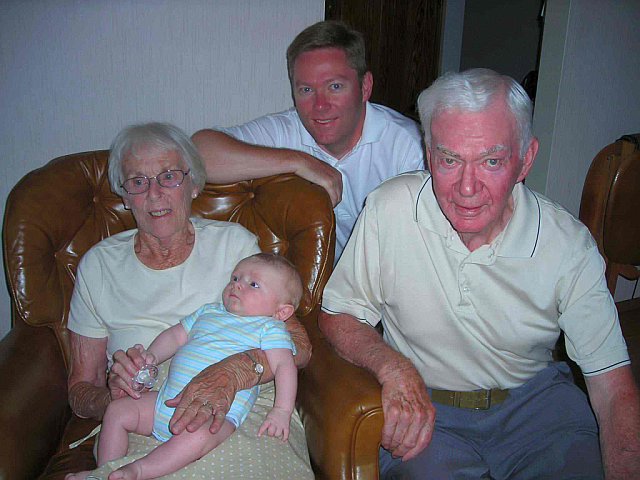
Ode to my father

[UPDATE: It’s Father’s Day, 2015.  It’s been 5 years since I wrote this. I added some more thoughts at the end.]

Father’s Day is upon us.  My dad passed away recently and of course my thoughts turn to him today.

He had a certain style and flair, even in his last act.  He passed away on April 19 at 89 years old.  On the first day of my new job in Prague.  In the midst of the volcanic eruptions.  Imagine the challenge of getting to Canada in time for his funeral when only 750,000 of my closest friends were stranded too.  Thankfully, I made it.

He was a man of profound gifts and talents.  Certainly one of the smartest people I’ve ever known.  That’s saying something given my 24 years in high tech surrounded by smart, highly educated people.  He’d recite formulas and theorems for his grandchildren, a couple of whom were educated as engineers.  They were surely stunned that he remembered the stuff they were trying so hard to learn in college.

He had a clear, tuneful voice and probably could have been an accomplished performer had he put his mind to it.

He was an athlete, though I’m not sure he ever fancied himself as one.  Just a few years ago, he laced up his old hockey skates, which were the consistency of golf glove leather.  Soft.  No support.  He stepped on the ice and proceeded to glide the length of the rink with a couple of strides.  Amazing.

He learned golf at the age of 40 and became better than 95% of those who play the game.  Most people who play that well start very young when it’s much easier to learn.

His career took him around the world many times over, and he knew a lot about a lot of cultures and places.

For all of these gifts, he was human too.  I sometimes think that the smartest have a hard time enduring the rest of us.  He didn’t suffer fools.  I wouldn’t want to be on the other side of an argument with him at work, just as I didn’t at home.

Age made my father wiser and mellower.  And it’s the latter part of his life I most want to emulate.

May we all be so gifted, and learn the humility to match.

Happy Father’s Day.

UPDATE: It’s Father’s Day, 2015.  I’ve been working away at my start-up for almost 3 years now.  Being a CEO and leader has illustrated for me – and those around me – all of the ways in which I’m both flawed and talented.  My dad was about my present age when I was a teen, when I experienced his mid-aged intensity in all its glory.  More than ever, I know I am my Father’s son.

3 generations: my parents, my son and me