
“Creative destruction”: Netflix gets it

About 15 years ago (!) I worked for Reed Hastings.  He was not one for sitting pat.  At the time, he realized that the software category of Software Quality Assurance (SQA) was going to consolidate.  And that you could either embrace that eventuality,  or hold on to the past.

He embraced it, by seeking a merger between his baby Pure Software (he was the founder) and Atria.  Soon thereafter, the combined company was part of Rational and is now a product suite at IBM.

Reed is at it again.  Netflix is separating its DVD-by-mail service from its live streaming service.  I loved the quote from Engadget today:

What really happened here is quite simple: Reed Hastings just put a gun to the side of his DVD-by-mail business and pulled the trigger. Given that he aimed for the ankle, though, it’ll probably take a while for it to completely bleed out. But hey — proactively putting a fading business out of its misery sure beats bleeding for it on the balance sheet.

Joseph Schumpeter and more recently Clayton Christensen have written about creative destruction and disruptive technologies.  Reed is one a few high tech leaders that has the courage to implement what the rest of us know: do unto oneself before it’s done to you.

Here’s the bit that stops others from doing the same: Netflix’s share price, and perhaps even near-term revenue, could suffer.  For most of the industry, one can’t tolerate the thought of taking a step back to take two forward.  And hence the balk at such bold moves, fearing the reaction of others.  Like shareholders or pundits.

Perhaps the definition of “courage” is not fearing the reaction of others?  Game on, Reed.
I’m not worthy! Or am I?

I was surprised to randomly discover that I was nominated for the following award:  http://boston.blogger.cbslocal.com/most-valuable-blogger/vote/misc/

It proves that one’s readership can reach into many unexpected corners of the Internet.

Given my blogging has been silent for a few weeks (massive corporate strategy project followed by long vacation in mental recovery mode), maybe I’m not so worthy of a vote.  But if you’re willing to vote for me, by all means do.

I promise to be a better blogger real soon.  😉

How to stop your car from being towed, Prague style

My wife sent me the following email today.  It about says it all…

“Tried to pull into garage.  Electricity out, door won’t open.  Park on the street, go get ice cream.  Come back, car being lifted onto tow truck.  I stand in front of tow truck, refusing to let it leave.  Police came, I pay off the cop $40, get my car back.  Home now.”

The Czech Republic’s police force was notorious for pocketing traffic fines on the spot.  Maybe it’s still the case.  Though one could argue it’s more convenient than the U.S. alternative of remembering to write a check and mail it in.

Was the Prague transit strike a good thing?

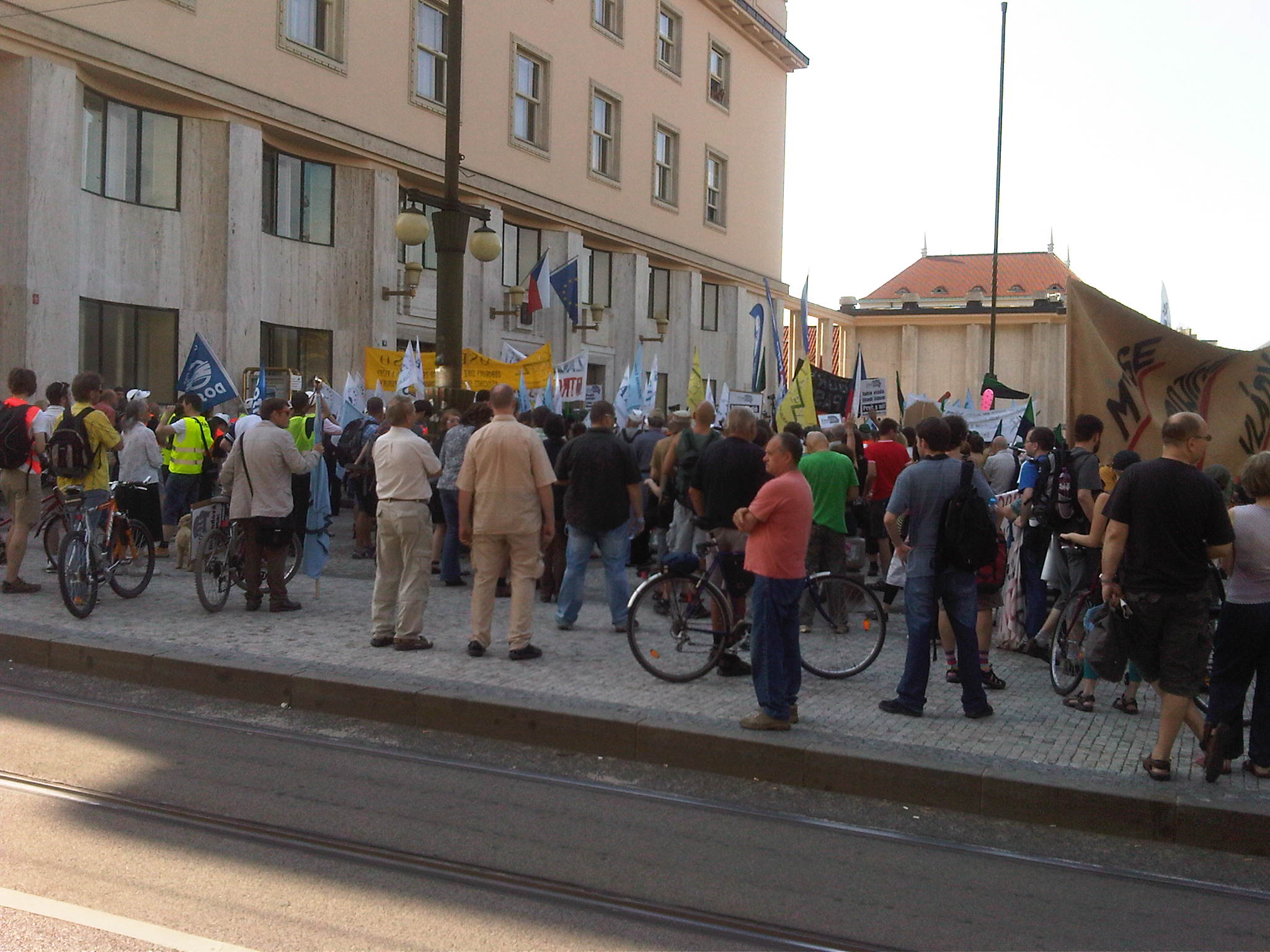
Prague transit strike demonstrators

I’m not a big fan of unions, at least in the U.S.  But I thought the Prague transit strike today was a good thing in a way.  Why?

I can’t imagine that before 1989 any such strike would occur. Or, if it did, that there would be severe reprisals by the police and who knows else in the government.  Including violence and long term damage to the lives of the organizers.

So, to see a peaceful gathering of strikers today, with the police lingering in the back dressed in ordinary uniforms, said volumes about the freedom of speech that the Czech Republic now enjoys.  The right to assemble & demonstrate, regardless of the merits of your position, is a huge element of any open and democratic society.

March on, Czech colleagues.

The probabilities of success?

There are several ways you can succeed.

For example, let’s say Hope has a success rate of 5%.  Prayer might also have the same odds of 5%.  Now multiple these two powerful forces together.  Hope times Prayer = 25%?

Actually, no.  It’s .25%

You might sense the sarcasm here.  Though I literally have seen organizations multiply low-probability tactics and believe that overall success is more likely. As they say, hope & prayer are not a strategy.

Staring chauvinism in the mirror

We recently hired a bright, talented young woman into my organization as a product manager.  She had interviewed with members of both my staff and that of colleagues by the time she met with me.

The people in my staff and peer departments are almost entirely comprised of males.  I asked her whether she sensed any chauvinism during the round of interviews.  To which her response was, “no”.

Later, I felt regret for asking the question.  Whereas I was asking in part to establish empathy (as in, “I’m not a chauvinist and won’t abide it in my team”), I realized the dilemma I could have exposed her to.

In effect, she could only say “no” because if she said “yes, I sensed chauvinism” then she could think I had a reason not to hire her on the basis of fit or avoidance of future conflict.

On further reflection, I realized I asked the question because my own ability to assess the situation is limited.  Limited by a cultural gap between me and the primarily Czech workforce she would be working with.  In other words, I don’t know what chauvinism is, or is not, in the Czech culture.

In the year I have been here, there have been times where I felt that I was able to sense cultural differences.  This situation reminded me that there are many things I don’t (yet) understand.  And that my cultural norms can’t simply be projected onto another culture.  Disconcerting….

Let the learning continue.

This blogging stuff is hard work!

The data analytics guy in me makes me check my blog stats regularly.  The conclusion: the less frequently I write, the less daily visitors I get.  Blogs at a cadence of 5 days or less create a much larger readership than at a slower cadence.

I struggle to think of something interesting to say every 5 days.  Especially given the workload at the office and the obligations of home life.  Maybe I’m not a born blogger?  😉

What do you want to hear about?

Stay tuned….

Your move, Islam

Osama Bin Laden’s death is a moment of choice for Islam.

Years ago, I had a heated debate with a (very) Republican friend.  I contended that Al Qaeda was in a battle for the hearts and minds of mainstream Islam.  And that the U.S. was a pawn of sorts.  We represent what Islamic fundamentalists oppose; secularism, capitalism, democracy, gender equality.  And moderate Muslims’ empathy toward U.S. culture is what those fundamentalists wanted to prevent.

Today’s event is another decision point for Islam: will Bin Laden become a martyr to others than the extremists?  Or will moderate, mainstream Islam close this chapter of history by turning its back on terrorists?

Choosing to oppose terrorism is not unto itself an endorsement of the U.S.  It’s simply a statement of what Islam does not stand for.  And the lack of support for terrorists means that their safe havens will wither and die.

Your move, Islam.

One Year Anniversary in Prague

It’s been one year since I arrived in Prague, haggard from a volcano-interrupted journey.  Said journey ended up being me, a briefcase, and my urine-soaked cat in a crate after 25 hours of confinement.

I’ve written in previous posts about what I love and (un)love about Prague.  So no need to sum it up again.

That said, my arrival in Prague is inextricably linked to the death of my father on the third day I was here; which was also my first day of work.  The first call I made from Prague back home was to my sister to inquire about my dad’s (seemingly non-life threatening) condition in the hospital.  My sister replied, “Donny, Dad died 10 minutes ago”.

I wrote this eulogy of a sort last year.  My arrival and his departure will be forever linked….

Things I love and (un)love about Prague (Part 3)

I wrote previously about this topic here and here.

LOVE

Czech Courtesies.  Virtually everyone offers their seat on the tram to the elderly, or says “hello” and “goodbye” on an elevator.  The receptionist in my building will loudly scold those who fail to greet her in the morning.  Good for her.

The automatic replenishment of one’s beer without asking (this can also be hazardous to one’s sobriety).

Laissez faire.  Want to enjoy a beer on the street?  You won’t be arrested.  There is a form of tolerance here for personal choices (indulgences?) that exceeds American standards by far.  I remember the huge legal debate leading up to – gulp – sidewalk restaurant seating in Boston.  And this is one of the most liberal cities in the U.S.

The attitudes of Expats.  First, let me say that I have made friends with some really nice Czechs both at work and in private life.  But the expats here have a consistent trait about them: they are very open to new friendships.  I think being an expat creates great empathy for other expats, and with that comes approachability.  When move back to the U.S., I will look at immigrants through a new lens.

(UN)LOVE

Retail banking.  A prime example of the state of the service sector.  Getting my wife a debit card linked to a joint account took 3 months, 4 visits to a retail banking branch and 6 hours’ worth of time.  And this is from a bank owned by an Austrian parent company with presumed Germanic efficiency.

Lack of fresh green vegetables.  This despite the proximity to the year-round Mediterranean growing zone.  I long for selections of fresh lettuces, chards, herbs, spinaches, etc.  Farmers’ markets soften the blow, but only for a couple months a year.

Dog poop.  The city clearly ignored my protestations in this blog last year;  the depositing of poop on pedestrian pathways continues unabated.  Stepping in poop is inevitable.  You only hope it’s on a rainy day where you can use a puddle to dissolve the crap from your shoe.

No great Chinese food.  Please, please, please tell me I’m wrong.  I’ll be darned if I can find any great restaurant reviews in the usual English-language places like Expats.cz or Czech Please.